
How to Assess Peptide Purity Before You Buy

A vial label can claim 99% purity, but that number means very little if you cannot connect it to a real batch, a clear test method, and a supplier prepared to stand behind it. If you are researching how to assess peptide purity, focus on evidence you can verify rather than packaging, price, or marketing language. That approach gives you a much better basis for choosing products responsibly.
Peptides are sensitive compounds. Their quality can be affected by synthesis, purification, handling, transport, storage, and reconstitution. A high stated purity is a positive sign, but it is only one part of a bigger quality picture. Identity, quantity, sterility where relevant, and the integrity of the supply chain matter just as much.
How to Assess Peptide Purity From a COA
The most useful document to request is a certificate of analysis, usually called a COA. A credible COA should be tied to the exact lot or batch of the product you are considering. If a supplier provides the same generic PDF for every peptide, or the certificate does not show a batch number, treat it as supporting information at best, not proof of the vial in front of you.
Start by matching the product name, lot number, testing date, and stated amount on the COA with the product listing and label. Small naming differences can happen, especially with peptide salts, but unexplained discrepancies deserve a direct question. A recent report is generally more useful than one produced years ago for an unrelated lot.
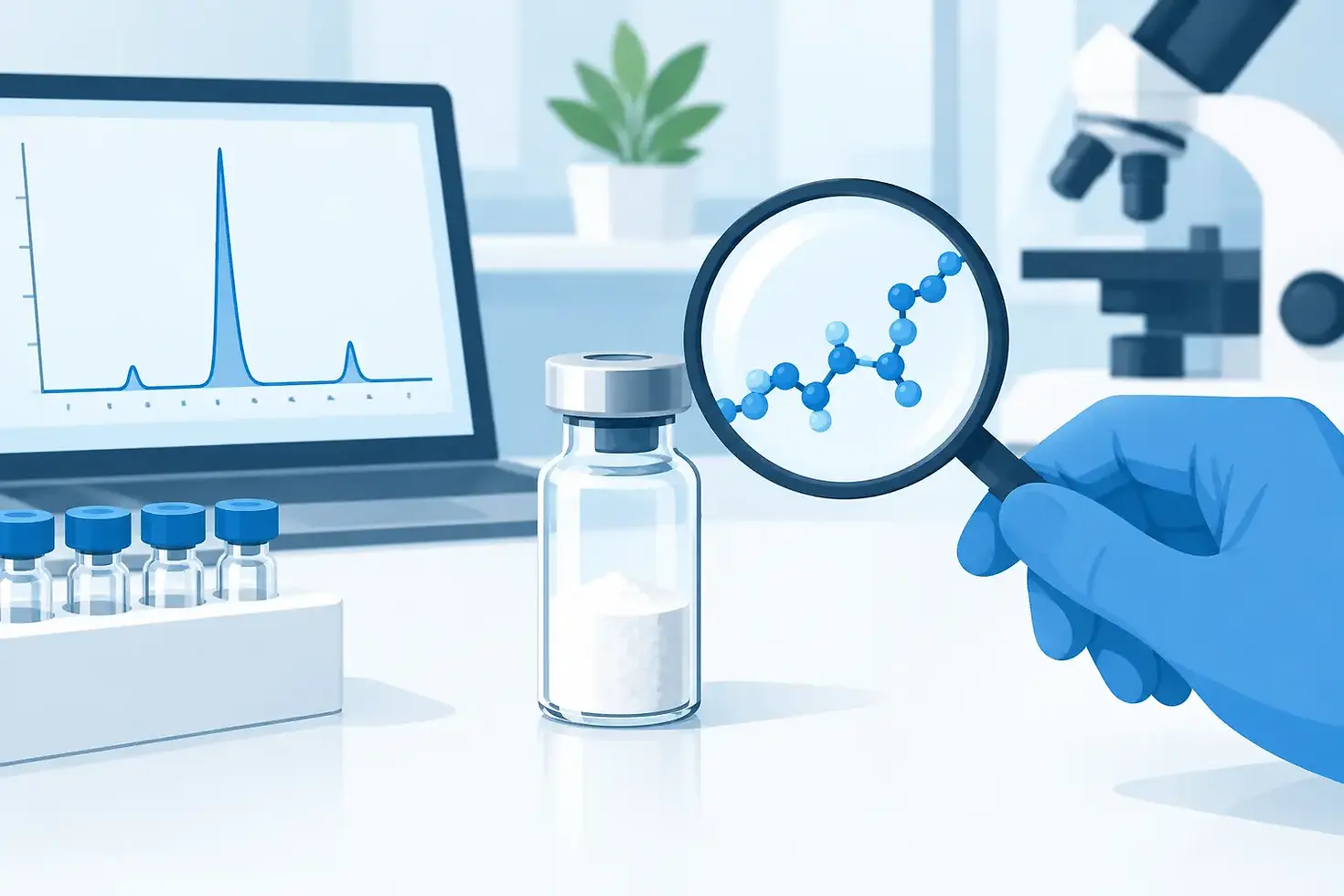
High-performance liquid chromatography, or HPLC, is the method most often used to report peptide purity. In simple terms, it separates compounds in a sample and measures the main peptide peak against other detected peaks. A reported purity of 98% or 99% often refers to the relative area of that main peak. It does not automatically confirm that the vial contains the correct peptide at the claimed quantity.
A worthwhile COA should show more than a single percentage in a table. Look for the actual chromatogram, which is the graph produced by HPLC testing. You want to see one clear dominant peak, with smaller peaks identified or accounted for where possible. A perfectly clean-looking image is not a guarantee, but a vague, cropped, or unreadable chromatogram provides little confidence.
Purity Is Not the Same as Identity or Dose
This distinction is where many buyers get caught out. A sample can test as highly pure while still being the wrong compound, the wrong salt form, or present in less material than the label claims. HPLC is valuable for purity, but it works best alongside identity testing.
Mass spectrometry is commonly used to confirm molecular weight and support peptide identity. On a COA, it may appear as MS, LC-MS, or MALDI-TOF. The reported molecular mass should align with the expected peptide and its stated form. This does not require you to become an analytical chemist, but a supplier should be able to explain plainly what testing was performed and what the result confirms.
Quantity is another separate question. A vial marketed at a stated amount should be assessed through appropriate content or assay testing, not inferred from the purity percentage alone. For example, a product could be 99% pure by chromatographic area but contain less total peptide than the label indicates. That is why serious quality review looks at purity, identity, and content together.
For products intended for injection, chemical purity alone is never enough. Sterility and endotoxin controls are separate safety requirements. A clean HPLC report cannot tell you whether a vial is sterile or free from bacterial endotoxins. If those claims are relevant to the product, ask whether sterility and endotoxin testing were completed for the finished lot, not merely assumed from the manufacturing process.
Ask the Supplier Questions That Have Clear Answers
A dependable supplier should not make you feel unreasonable for asking about quality documentation. You are not looking for a sales pitch. You are looking for specific, consistent information that can be connected to the item you may receive.
Before ordering, ask whether the COA is batch-specific, whether testing is performed by an independent laboratory, and which methods were used for purity and identity. If the product is supplied in a vial, ask how it is stored before shipment and what storage conditions are recommended after delivery. Direct answers are more reassuring than broad claims such as “pharmaceutical grade” with no supporting detail.
Four practical questions can quickly reveal how transparent a supplier is:
Is this COA linked to the same lot number shown on the vial?
Does the report include both purity testing and identity confirmation?
Was testing completed by an independent laboratory or only in-house?
Are sterility and endotoxin results available when the product is intended for injection?
No supplier can eliminate every risk with a PDF. However, a supplier that provides traceable documentation, communicates clearly, and maintains consistent handling standards gives you a stronger foundation than one that relies only on attractive labels or unusually low pricing.
Know What Visual Checks Can and Cannot Tell You
Once a product arrives, inspect the outer packaging and vial before use. Confirm that the label matches your order, the lot number corresponds with the documentation provided, and the vial is intact. Look for signs of poor handling, including a damaged stopper, a compromised seal, missing product information, moisture damage, or an unlabeled container.
Lyophilized peptides are often supplied as a dry powder or compact cake. Their appearance can vary by peptide and formulation, so visual inspection cannot prove purity. A vial that looks normal may still have identity, dosing, or contamination issues. Likewise, a slightly different appearance does not automatically mean a product is defective. Use appearance as a basic screening step, not a laboratory result.
After reconstitution, unexpected cloudiness, visible particles, unusual discolouration, or a changed appearance should be taken seriously. Do not try to solve uncertainty by guessing, increasing the amount used, or relying on online anecdotes. Stop and consult the supplier or a qualified healthcare professional when there is any question about product integrity.
Storage Has a Direct Effect on Peptide Quality
A genuine, well-tested peptide can still lose quality if it has been stored badly. Heat, light, repeated temperature swings, and unnecessary handling may contribute to degradation. The right storage conditions depend on the specific peptide and whether it is still lyophilized or has been reconstituted.
Follow the product-specific storage directions rather than applying one rule to every vial. Check delivery promptly, avoid leaving packages in hot vehicles or direct sunlight, and do not use a product if it arrives clearly compromised. When ordering in Canada, choosing a supplier with clear shipping practices and responsive customer support can matter as much as the original test report.
Be careful with claims that a peptide remains stable indefinitely at room temperature or that refrigeration solves every problem. Stability is compound-specific and depends on formulation, time, packaging, and handling. Honest guidance reflects those limits instead of making guarantees that sound convenient but cannot be supported.
Watch for Signals That Quality Claims Are Weak
Price alone is not a purity test, but unusually cheap products can be a reason to look closer. Quality synthesis, analytical testing, controlled handling, and secure packaging all cost money. A dramatic discount is not proof of poor quality, yet it should not replace due diligence.
Other warning signs include missing lot numbers, certificates with no laboratory details, images that cannot be read, conflicting product information, and customer service that avoids direct questions. Be particularly cautious when a seller makes medical guarantees, promises identical outcomes for every person, or suggests purity testing is unnecessary. Responsible suppliers explain what they can verify and where the limits are.
You should also be wary of treating forum posts, before-and-after photos, or personal experiences as evidence of purity. Someone may report a desired result from a product that is inaccurately labelled, while another person may have a different response for reasons unrelated to product quality. Analytical documentation is more useful than anecdotal feedback.
Make the Decision With the Full Picture
The best purchasing decision is rarely based on one number. A high HPLC purity result is encouraging when it is tied to the correct batch, supported by identity testing, and backed by transparent supplier practices. For injectable products, it must also sit alongside appropriate sterility and endotoxin controls.
At Nordic Pharma Canada, we believe customers deserve straightforward information before they purchase. If documentation is unclear, if the batch details do not match, or if a product’s handling history cannot be explained, it is reasonable to pause and ask more questions. Confidence should come from traceable quality evidence, careful storage, and responsible decisions, not from a label alone.




Comments